
Our friends Fredrik and Nancy are back for their 2nd winter exploring the coast of Baja California, Mexico! After spending over a year living in the wilds of Alaska, they discovered a love for Baja last winter — and their search for adventure in a warmer climate continues. Aboard their 17′ Salish Voyager, Wild Places, the pair are picking up where they left off, pushing south through the Sea of Cortez from Mulege to La Paz. Same boat, same spirit — brand new adventure.
Setting Off Across Conception Bay
Actually, it was Fredrik and Nancy, who returned from Alaska to Baja California. Our boat, “Wild Places,” has been nestled beneath tarps under a mesquite tree since we finished our voyage in the Sea of Cortez last January. This year, we planned to complete the Mulege to La Paz section of the coast.
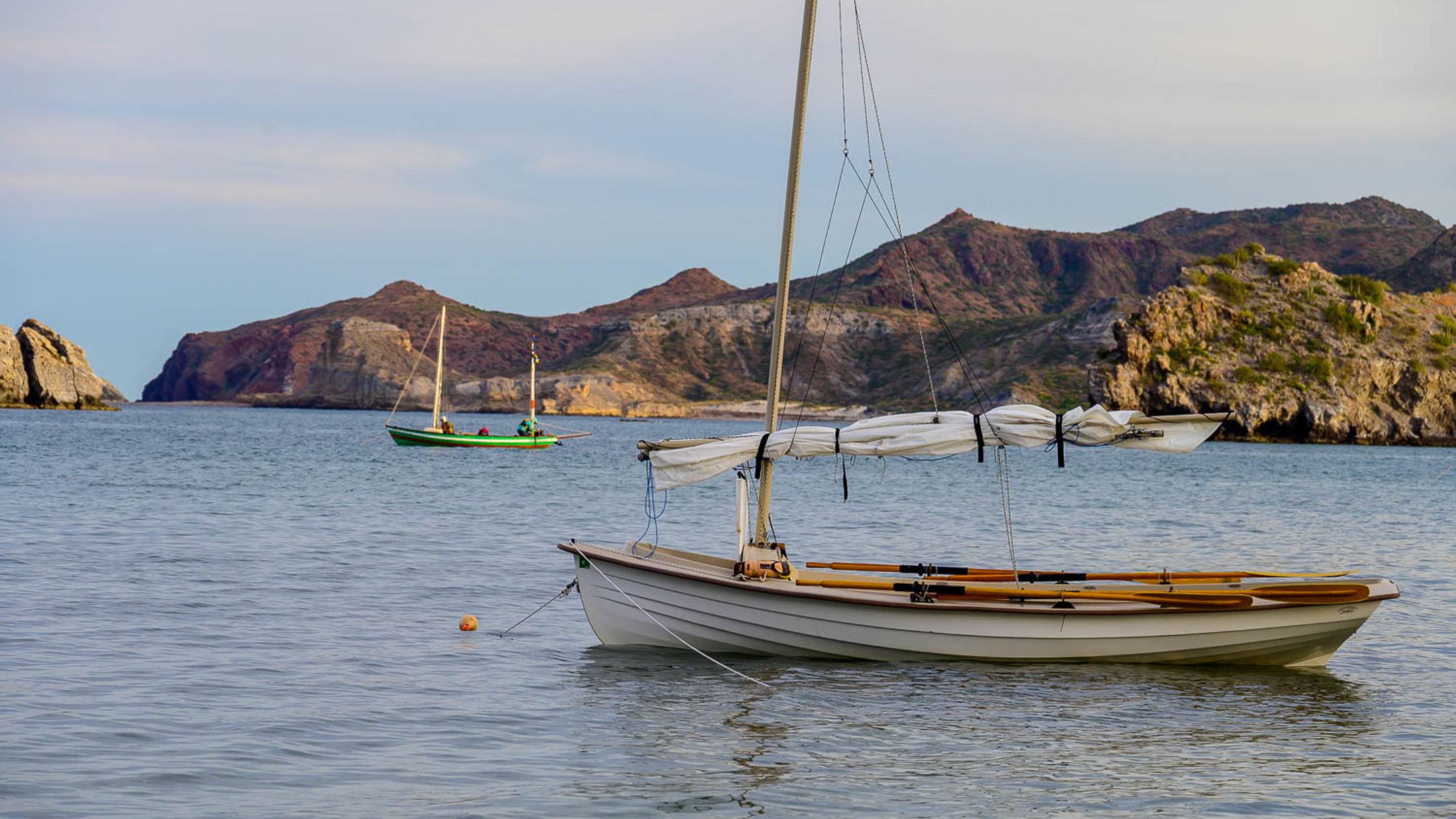
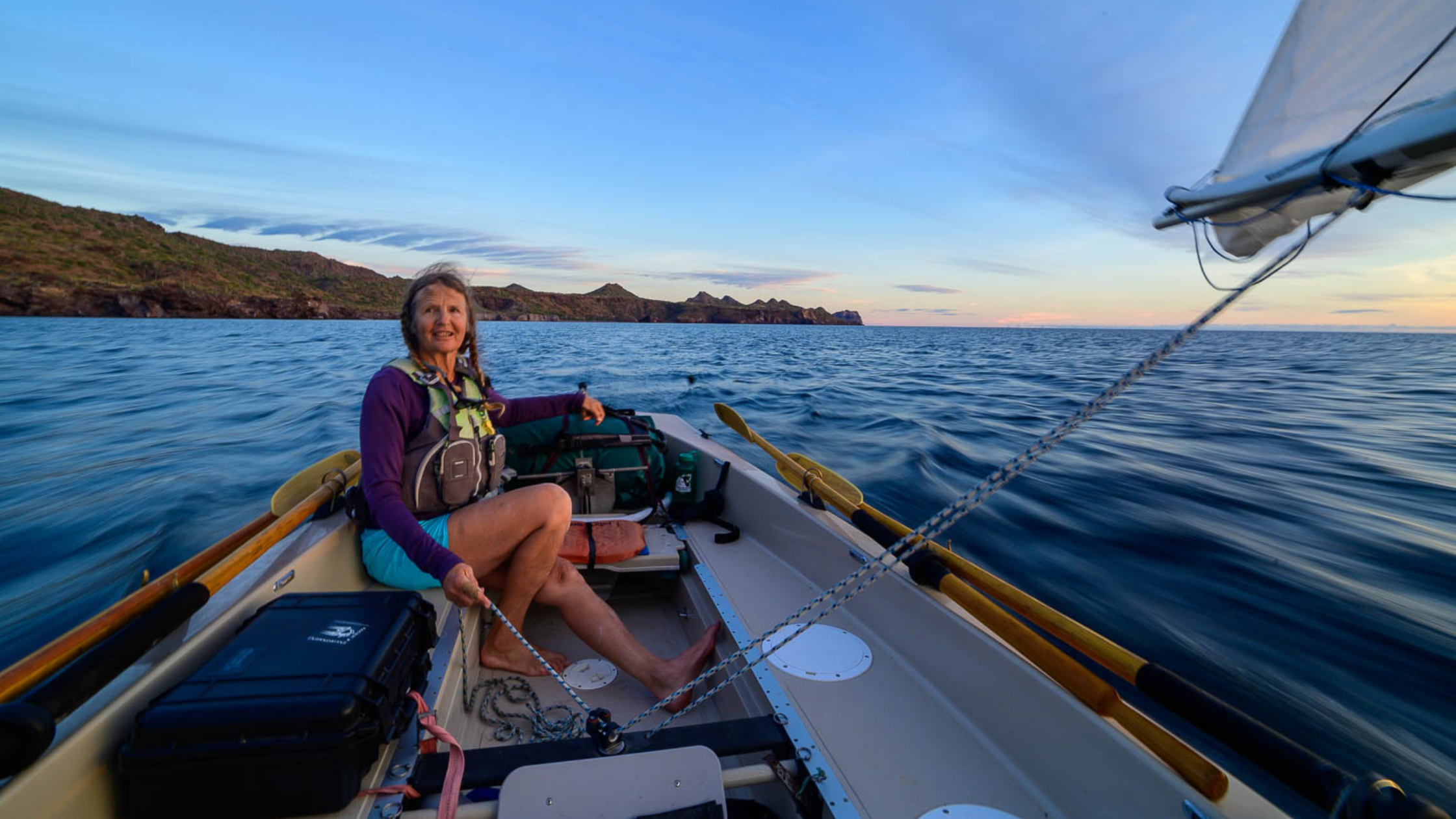
On a perfect day with a light south wind, Fredrik and I sailed across Conception Bay. A delightful downwind run brought us to Santa Domingo, the last protection before Punto Conception, and a great place to spend our first night out.
Camped near us was a sailing course from NOLS. We would leapfrog with this group for a few more camps. NOLS has been teaching sailing using Drascombe boats, small, rowable, and beach-landable vessels, for decades in the Sea of Cortez. We enjoyed learning about their boats and the techniques they used. However, the Salish Voyager makes the Drascombe look like a big boat.
Rounding Point Conception — And Waiting Out the Wind
Another lucky day followed, and we easily rounded Point Conception, which can be one of the trickiest points in Baja and has claimed multiple lives.
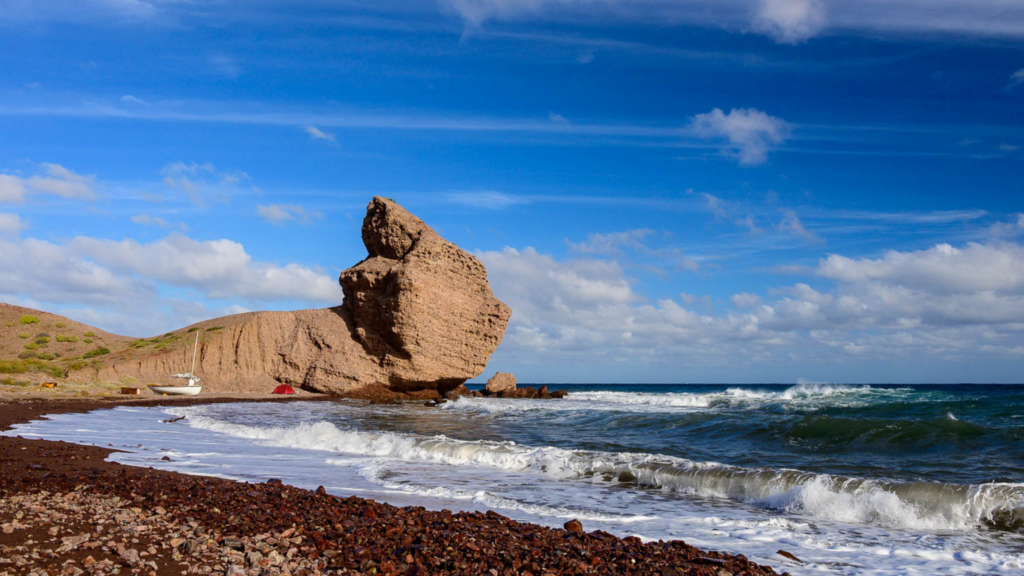
We snuggled into a cove a few miles south of the point. This would be home for five days. The first El Norte winds of the season were upon us. Far from feeling antsy to keep going, I relaxed into being here at last. With world news unable to reach me, I was finally free to contemplate the affairs of the cactus wren.
We slept under the stars. Orion ticking slowly across the sky served as a sundial in reverse. It was early morning when I woke Fredrik.
“It’s raining,” I said.
“What?” He asked.
“It’s raining,” I said.
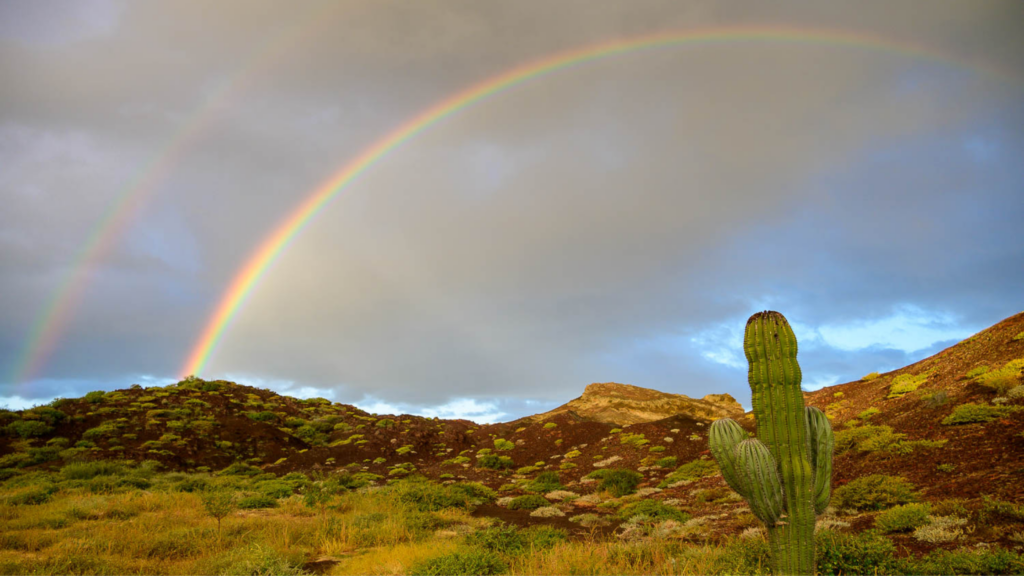
It didn’t make sense. As of last winter, many places on this coastline hadn’t seen rain in over two years. The cacti were visibly suffering. This year was different. This desert was verdant with leaves and thick with flowers. Plants I’d known for years by the texture of their bark, and the length of their thorns, were unfamiliar to me, leafed out and in bloom.
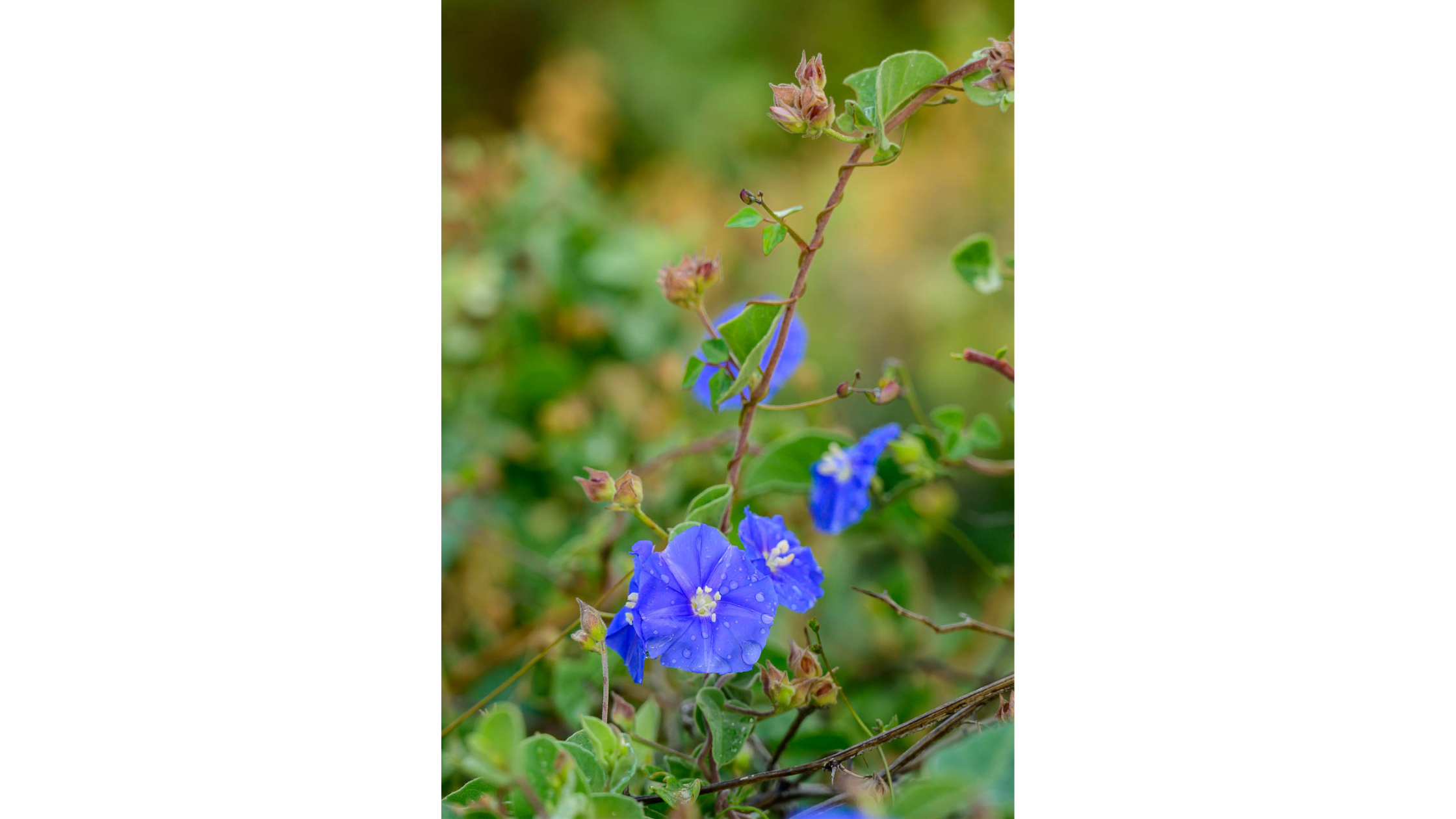
We set up the tent just as the sun rose above the horizon. After the rain, we wandered into the freshly scented desert chasing rainbows. Purple and blue flowers on trailing vines competed for attention with tiny white flowers barely centimeters above the sand. Butterflies were everywhere: yellow ones, cream colored ones, orange ones, and dark ones with long scissor-like tails.
When the wind lay down, we considered taking off. However, the surf was still intimidatingly large on our exposed beach. By noon, the surf was down, but the day breeze was cranking. By late afternoon, the day breeze was dying, but there wasn’t enough daylight to get us to our next port. Having time has always been our safety net. Our whole trip lay ahead of us. We could wait one more day.
The Roosterfish
Over the next couple of days, we headed south to Punta Coloradito and on to the small fishing village of San Nicholas.

Just past San Nicolas, I was sailing a moderate evening breeze. Fredrik was fishing. We planned to camp near Punta Pulpito, the ominous, dark, headland that had dominated our vista for miles. We were nearly there when Fredrik’s rod bent over hard. His forearms clenched.
“Fish!” He hollered.
I kept sailing. This fish wasn’t coming aboard anytime soon. When Fredrik finally got him, or maybe her, in close enough to get a glimpse, we saw a large, thick silver blue body crowned by a wild-looking set of fins coming like streamers off the top of its head.
“It’s a Rooster fish!” Fredrik said.
Rooster fish are notorious for fighting hard. “He’s gorgeous,” I said, right before he disappeared again into the blue along with much of Fredrik’s line. Again and again, the fish ran off with Fredrik’s line.
We considered dropping sail, which can be done single-handedly. But, with Fredrik aboard and fighting a big, energetic fish, I decided the whole maneuver would have little chance of going smoothly. We were offshore from where we wanted to camp, and this fish was still in the ocean. Finally, I just luffed sail and waited for either Fredrik or his fish to tire out.
When Fredrik finally grabbed the steel leader, the fish flew through the air and landed at my feet, wildly thrashing, with the hook still attached. I lifted my bare feet onto the side seats to avoid getting impaled on a flying hook.
Soon, the mainsheet was covered in fish blood. Watching the vibrant color and the life of this fish fade away made me sad. Yet, I, too, would enjoy fish tacos tonight. It’s part of the deal, I told myself. Still, it was a harsh reality, especially for the fish.
Rounding Punta Pulpito — and Six Lobster Tails
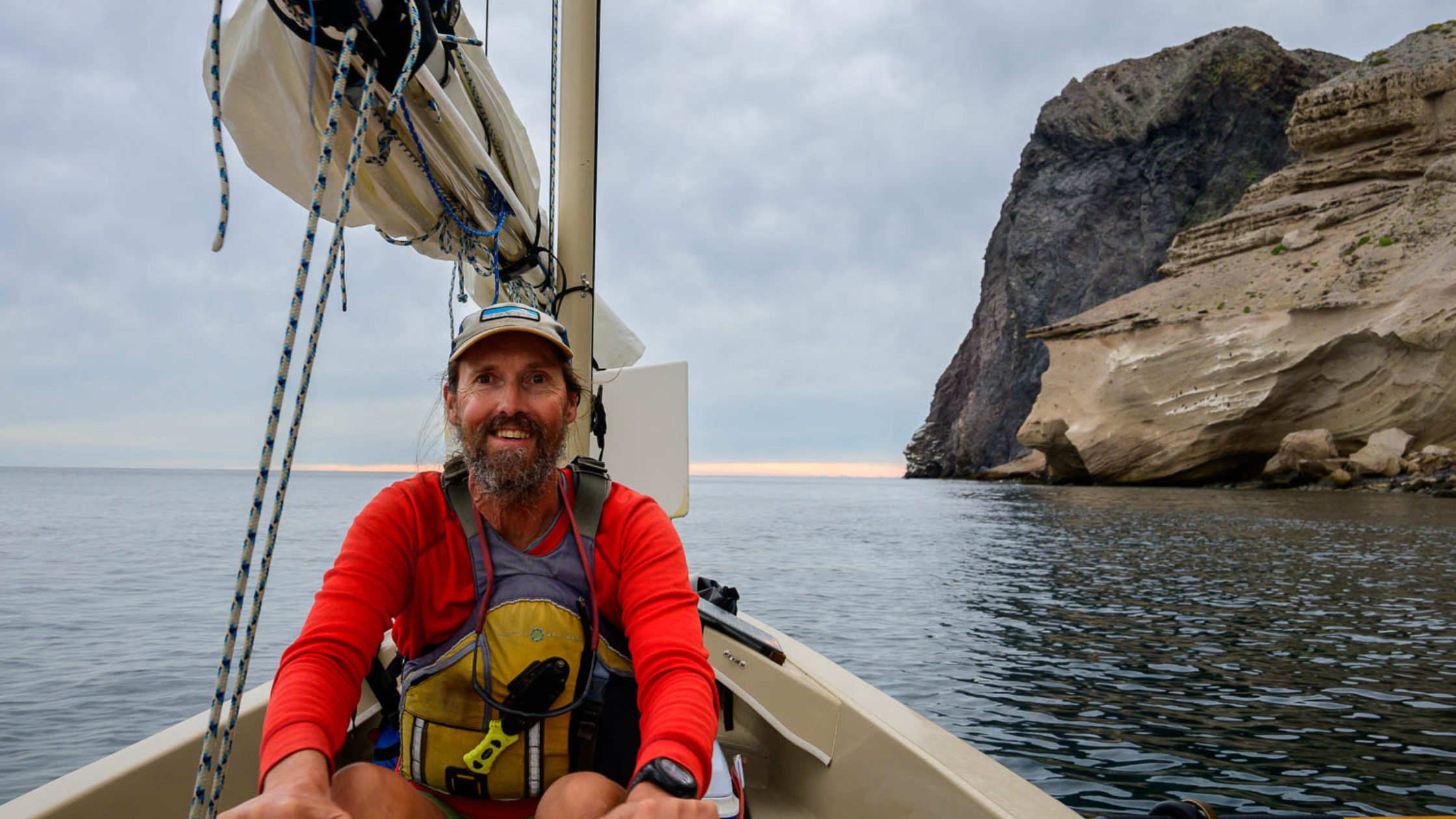
I was intimidated by the big headland in front of us. Punta Pulpito decides who comes and goes. I had rounded Punta Pulpito many years ago, on a solo kayak trip. Riding glassy rollers at sunrise, I had slipped inside a raft of sleeping sea lions. The same rock had turned Fredrik, me, and another friend around on a kayak trip just a few years ago.
This time, Pulpito was especially kind to us. Just after sunrise, we were sailing an easy beam reach. There was practically no swell.
“Do you want to row so we can go in close?” I asked.
To my surprise, Fredrik said, “Why not?”
Straining our necks, we looked straight up at the 475-foot wall. We lingered just outside a huge stone arch at the southern end. It was tempting to try to shoot through, but I reminded myself that we had a mast.
A Mexican fishing panga appeared off the point. We still had most of a big fish and no ice.
“Would you like a rooster fish fillet?” I asked him in Spanish.
It is the Mexican fishermen who usually offer kayakers fish. He glanced at his partner to confirm and then said, “Si”.
As I passed him a big filet, still cold from the ocean, he handed me a bag of ice. The ice alone thrilled me. Inside, I saw two lobster tails!
“Un cambio.” An exchange, he said.
The generosity of the Mexican people has always astounded me. It reminds me to be a better human myself. I didn’t know the half of it. By the time we got to camp and started to cook dinner, most of the ice had melted. There were six lobster tails in that bag!

It was well past Thanksgiving, but we celebrated that night. We were thankful for a safe and awe-inspiring passage around Pulpito, thankful for the amazing generosity of the people along our route, thankful for the fish who gave his all, and above all, thankful to have each other and the days ahead.
Swimming in Fish Soup at San Basilio
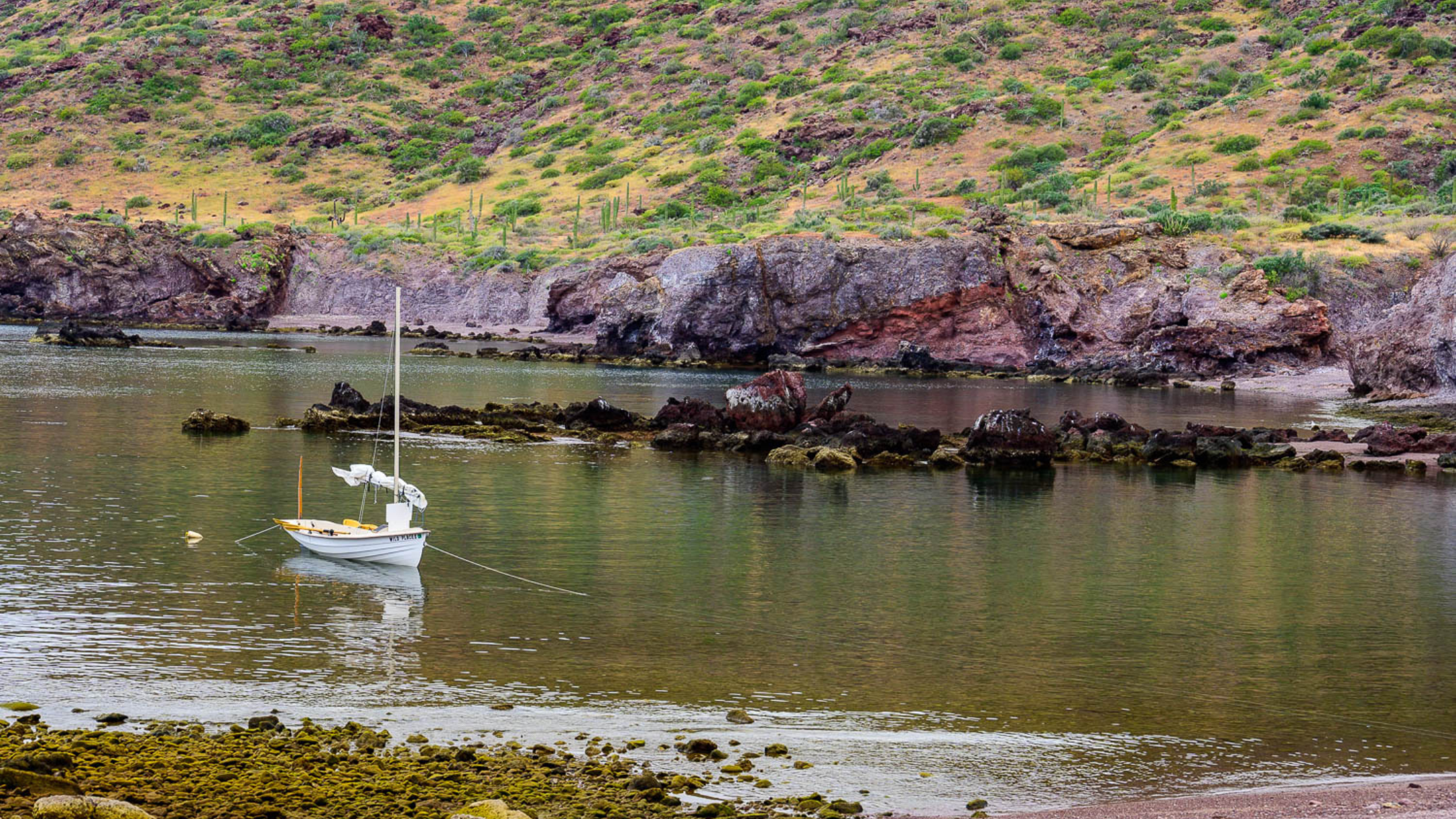
After Pulpito, we slept in a particularly picturesque little red rock niche. We love these tiny ports that only Wild Places can fit into.
However, we also use the well-known protected places along our route. San Basilio, a full half-round hook, with amazing rock formations, great snorkeling, and an anchorage for any weather, was our next stop.
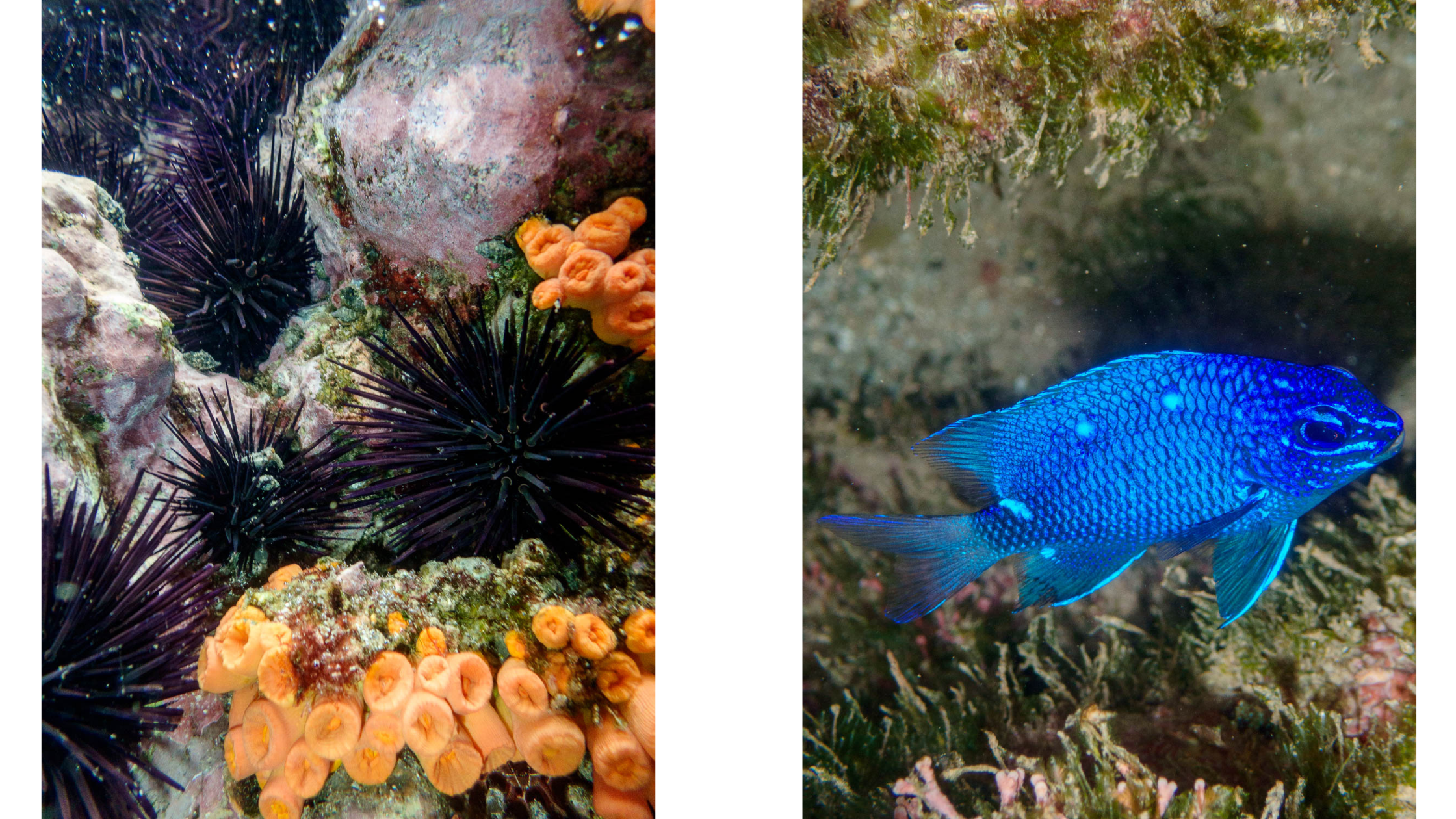
This was a busy place, but underwater, it was still Alice in Wonderland. We swam with King angel fish, Sea of Cortez angels, and multiple varieties of Puffer fish, which are well protected with spikes and balloon-like tendencies. I was surrounded by bullet-shaped fish, hundreds, thousands, maybe tens of thousands of them. The space around me was more fish than not fish. It was like swimming in fish soup.t least protection from outside waters.
Reading the Weather, Reading the Sea
The sailing seemed easier this year. We were having better weather, but we were also reading the weather better. We were making better decisions, reefing earlier, and communicating better. I anticipated the occasional moment of chaos and took it all in stride. We have owned Wild Places for just over five years. Maybe I was finally learning to sail.
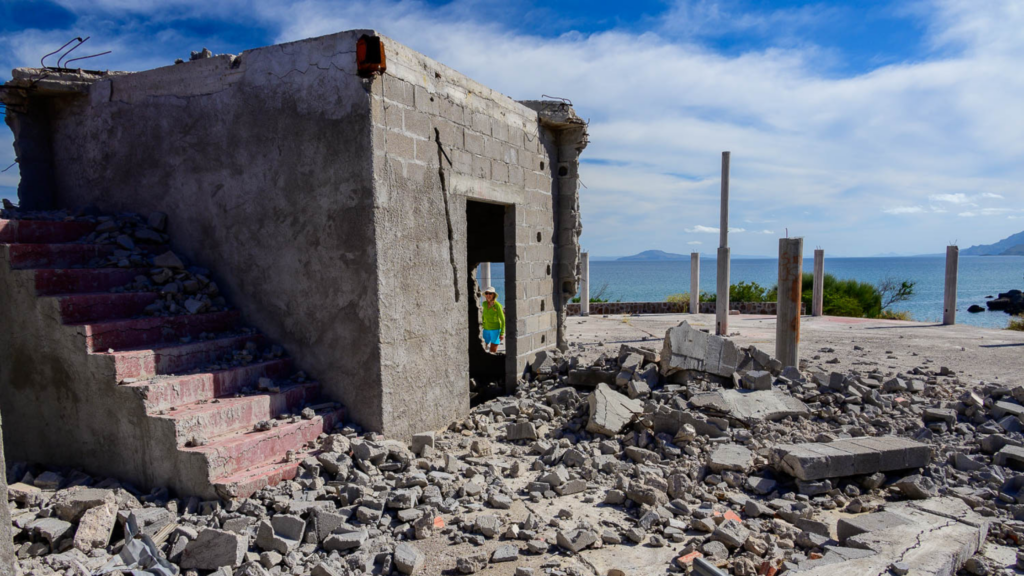
It’s hard to escape littered plastic bottles and abandoned fishing gear on beaches worldwide. However, Puerto Mangles had whole cinderblock buildings—once elegant structures—now fallen into ruin. Left in the blazing sun and pilfered for building materials, the end products of someone’s unrealized dream litter this peninsula. What was the story here? Did the apocalypse happen while I wasn’t looking?
We get our weather forecasts when we stop at villages with internet access or ask a larger boat. These reports quickly become old and are sometimes inaccurate. In many ways, I miss the days when a weather forecast was nonexistent down here. You woke up well before sunrise. Hiked to a saddle, or walked to the end of the beach, and felt for the faintest hint of a north breeze. If it was there, you went back to bed. If not, you packed and left. In addition, you looked around to see if the local fishermen were headed out.
These days, so few people are making a living off of fishing, and boat motors are so powerful that the weather no longer dictates everything, so this method is no longer completely reliable.
Pushing On to Loreto
Near the end of the Mulege to Loreto leg of the voyage, we planned to camp on Coronado Island and head into Loreto the following day. However, a multi-day el Norte was predicted. It made logistical sense to push on and get to Loreto. We could use the windy days to procure more food and water for the journey to La Paz.

Last season, life logistics had derailed our Loreto to La Paz journey. I really wanted to do it this year. Fredrik and I were both torn. Our hearts wanted to pull into a sweet little lagoon, watch birds, and maybe hike up the old cinder volcano that is Coronado. For once, we let the analytical, logical side of our brains take over. We pushed a total of 24 nautical miles that day. Tacking hard into a bouncy south wind, we arrived in Loreto at nearly dusk.
I wish we hadn’t. As it turned out, it was days before the North wind really hit.
Stay tuned for the next chapter of Wild Places photojournal as they continue their winter journey in the waters of Baja. In the meantime, you can read the backstory on Fredrick and Nancy’s Alaska journey from the beginning here.
Learn more about the 17′ Salish Voyager here.
If you enjoy reading about Nancy’s adventures, you can learn about her journey on horseback through Patagonia HERE. A second edition of her book, Riding Into the Heart of Patagonia, is being released in March.